
Updated September 2026
Get noticed by the press & social media...
Publicity Stunts & Cheeky PR Campaigns
One way to use Oddtoe...
The Publicity Stunt Package
For campaigners, press teams, and grassroots groups
Use Case: Publicity Stunts & Cheeky PR Campaigns
Oddtoe is an experiential design and generative-AI animation studio based in Melbourne, creating projection, installation, and animated work for events, venues, and galleries. This is a use case: how a campaign uses Oddtoe to pull off a publicity stunt or a cheeky PR campaign, from the first idea to the photograph that gets printed. The worked example is a set of carried heads. The same steps apply to an inflatable politician, projected animation for a protest, an ironic mascot costume, or a kinetic sculpture.
Come to Oddtoe for visual art with a point, designed by a political cartoonist — chief designer for a Washington DC paper, and an editorial cartoonist before that. That background matters here, because a photograph at a rally and a daily cartoon are the same problem. You get one picture to make the argument, and nobody sticks around for an explanation. The stunts people remember passed that test: the Trump baby blimp over Parliament Square, or the pink boat Extinction Rebellion parked in Oxford Circus.
Let's look at three steps in the process...
Three Drawings from the Sketchbook
Oddtoe can handle the first three stages of a stunt — where the idea starts, how it gets designed (sketches, 3D CAD), and how people, your staff or contractors, carry and handle the protest or publicity stunt artwork.
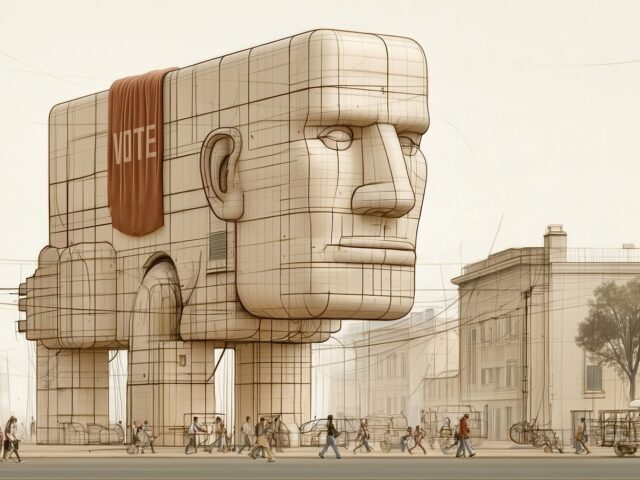
Ideation
I do love this stage. What could that front-page photo look like? How can your brand or movement go viral? Art and humour are Oddtoe’s thing. The idea, the feeling the art stirs, and your organisation’s message all get worked out here.
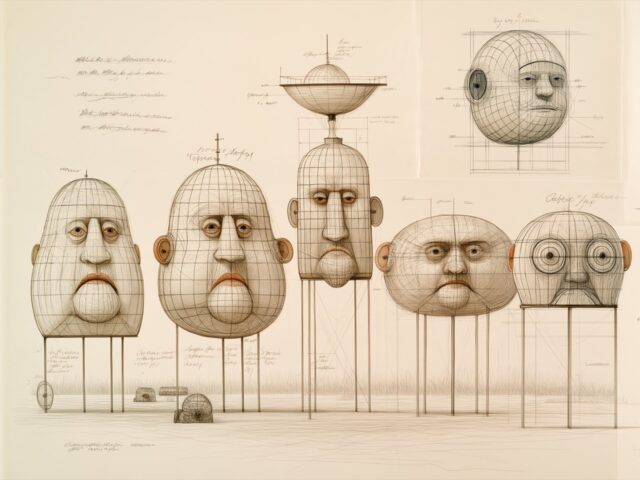
Sketching
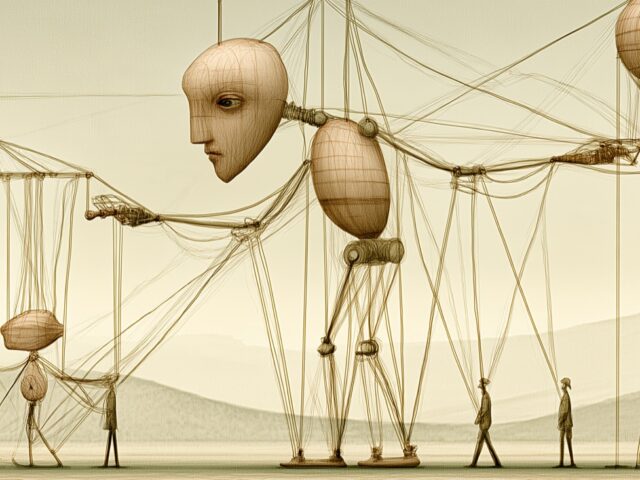
Everything starts on paper, on a grid. Proportions get argued out flat, front and side, long before anything gets cut. Here, a series of politicians’ heads are sketched with the poles that the protesters will carry. Get the sketch right and the impact of the art shows for the first time.
Humans & Movement
Working out how anyone actually carries the art. Where they stand, how many people it takes, how the weight sits on a shoulder after an hour, whether it can turn a corner without a traffic jam forming. Oddtoe works out the carrying and the moving for you. Leave it until the morning of the march and you are solving it in a crowd.
Earned media, and how to count it...
What a Stunt Does to Your Numbers
A politician’s face at balloon scale, parked where a rally is already going on. Nobody had to stage anything. Out come the phones.
So what does a stunt like this do for your numbers? Quite a lot, and all of it can be counted: coverage, shares, search traffic in the two days after, and the figures your board actually reads.
I like the tracking in place before the day. Oddtoe shares a founder with the Datalabs Agency, a data visualisation studio, so a dashboard that shows whether the stunt worked can be part of the job.
Steal one of these
6 IDEAS FOR YOUR NEXT RALLY OR PUBLICITY STUNT
Six ways to be the photograph the news runs. Roll over a circle and pick the one your organisation could pull off.
Want one of these for your organisation? Send the date and the message. More cheek in the gag cartoons.
Campaigns, PR agencies, unions, and NGOs
Who Commissions Work Like This?
Non-profits and NGOs, grassroots campaigns, unions, advocacy organisations, political campaigns, and PR agencies with a brand that wants a publicity stunt. What they all have is a date in the diary and something they need people to see.
Campaigns with a fixed date — a launch, a vote, a summit — need one day to produce a month of coverage.
Unions want objects that come out again and again, because the same members turn up several times a year.
NGOs and advocacy organisations need artwork that still works when volunteers in three cities are running it and there is no designer in the room. That means artwork files anyone can pick up.
Political campaigns buy artwork and objects the way they buy everything else. Oddtoe has done fundraiser illustration for a US House candidate.
Agencies working for any of the above are welcome too: see experiential marketing.
One idea, followed through
A STUNT, FROM BRIEF TO FRONT PAGE
The bit that is not a service
Why Oddtoe Likes a Stunt
Street art is punk rock for visual artists. You do not need a gallery or a commission or anyone’s permission, and it gets seen by people who never decided to look at art that day.
That is most of why this subject grabs me. A head carried down a street is doing the same job as a paste-up on a wall at four in the morning — putting the argument where people actually are.
I make my own work as well as client work, and sculpture street art is where I want to take that next. So when a publicity stunt brief comes in, it is about the closest thing to what I would be making anyway.
The practical upside for a campaign is that the person designing the object has a stake in whether it works. I want the photograph to be good for the same reason you do.
Light enough to carry, built to last...
Designed to be Carried »
Crated, shipped, and back for the next one...
« Built to Travel Easily
Objects, artwork, and the footage afterwards
What Does a Campaign Actually Get?
The object, the artwork it came from, and the photos and video from the day. All of it is yours to keep, crate included, and it goes out again at the next action.
• The object — in this example four oversized heads, built light enough to carry
• The character artwork — the same designs flat, for placards, posters and social
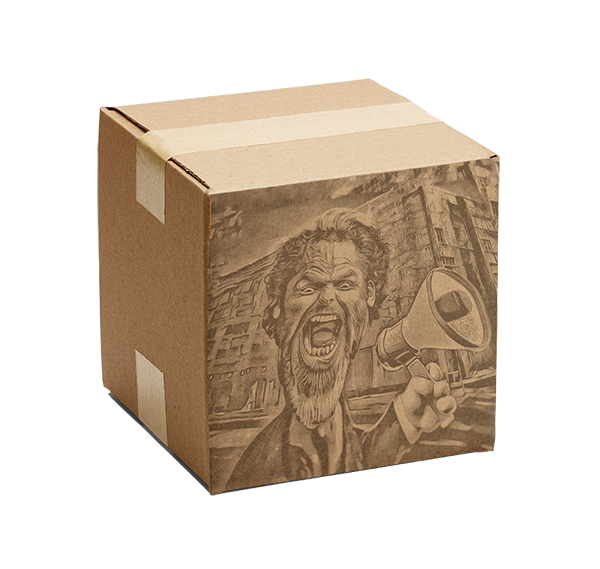
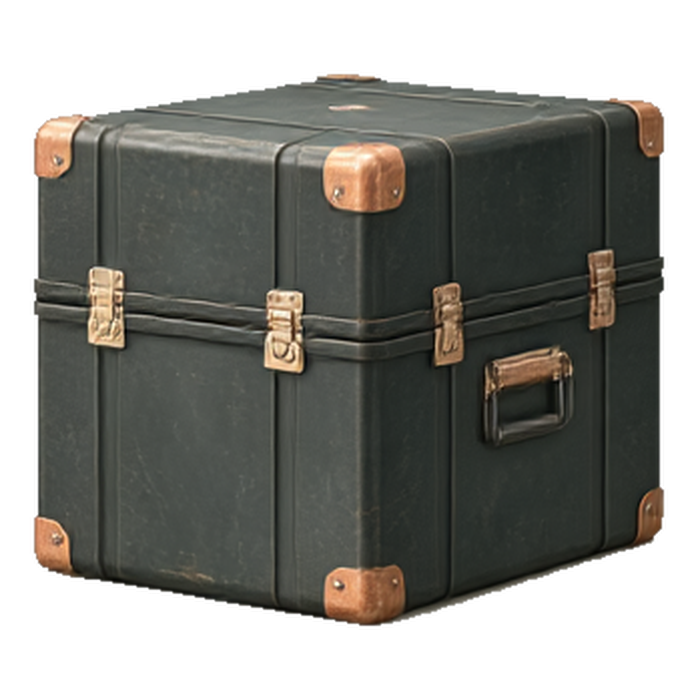
• A crate it packs into and travels in
• Photos and video from the day, ready for news editors and for phones
People tend to forget about the artwork. Because the object is built from finished character designs, the campaign also owns drawings that work on a poster, a placard, a t-shirt and a phone screen without redrawing anything.
It can be whatever the idea needs: carried heads, a giant inflatable, a mascot costume, a kinetic sculpture, or a projection on a building after dark, with the same characters animated. They are designed together, so what goes up on the wall is the same character as the one in the street.
Everything in the box
What the Package Covers

Ideation
We work out what the action needs to look like before we work out what to build. Bring a date, a message and whatever you already have.
Visualisation
Character art, scale drawings, and the object shown where it will stand. You sign off on a picture of the thing, at the size it will be.
Feasibility
Construction and weight. How volunteers move it. Customs, quarantine and freight, if it travels. And the date, which nobody can move.
Fabrication
Designed in Melbourne, built by the right maker for the piece, here or near you. Finished so it photographs without glare, and made to come apart into a crate and go back together without a technician.
Project Management
I run the job myself: visual progress reports, an action plan against your date, and a press plan for the day, worked out with whoever handles your press.
Five
formats to choose from
One
travel crate
Full
character artwork
6–8
weeks, brief to day
Freight
and customs handled
Years
of reuse
One frame, one argument
Why a Cartoonist Designs This
A political cartoon and a publicity stunt photograph do the same job. You get about a second of someone’s attention, and if the picture needs explaining you have already lost them.
Oddtoe drew editorial cartoons at college in Delaware, then worked as political cartoonist and chief designer for a Washington DC paper. Years of picking which single image a political story runs with, and watching an editor bin the ones that missed, usually for being too clever.
More recently, an illustration and cover design for a US House candidate’s fundraiser — a donkey bullying an elephant. Blunt, and it still reads printed small.
The same instinct decides what a stunt object should be. Out of twelve photographs from twelve actions, a news editor runs one. The job is to be that one.
It also decides what to leave out. A head that needs a caption has failed, and so does one that turns into a blob from across a square.
Where the money actually goes
Placards, a Stage, or Something Built?
A campaign budget usually has one line for the visible part of an action. This is what that line buys three different ways.
| Placards | A hired stage | Something built | |
|---|---|---|---|
| What it costs | Cheap per unit, spent again every action | A large single-day hire | One build, spread over years |
| How long it lasts | One rally, if it does not rain | Gone by Monday morning | Years, in a crate between actions |
| What a news editor does | Scrolls past it | Crops it out of the frame | Runs it, because nothing else looks like it |
| Who has to operate it | Whoever is holding it | A crew and a technician | A few volunteers |
| What you own afterwards | Nothing | Nothing | The object and the character artwork |
Questions about
Publicity stunts?
Interested in seeing more…
built work?

Sculpture design case study of Oddtoe's limited edition, "Roman General with Pinkeye".
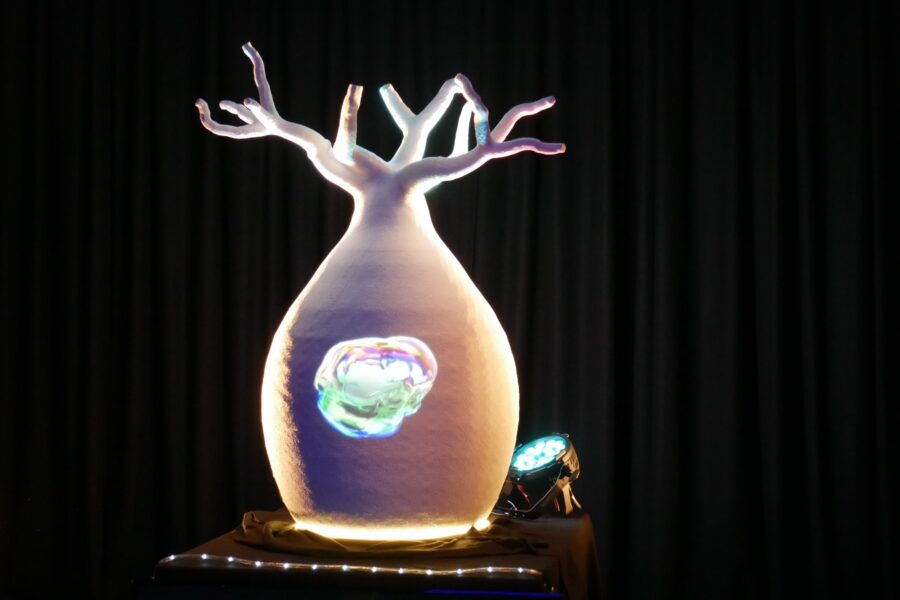
A 2.1-metre carved baobab, lit and projection-mapped, built for Oddtoe's children's show at the Melbourne International Comedy Festival.
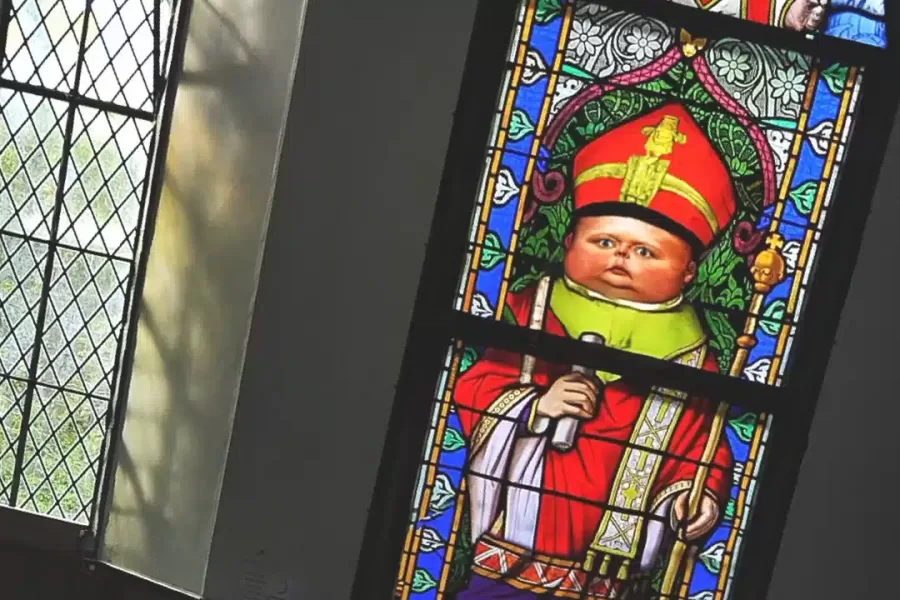
A church renovation with a sense of humor.

Tell me the date and what the picture has to say.
Got a stunt in mind?
"*" indicates required fields