
Updated August 2026
Animation with an artist at the wheel...
Generative AI Animation
Generative AI animation is animation made with AI image and video models under an artist’s direction — designed, directed, and edited like any other film. This page explains the medium, and how a Melbourne studio uses it for brands, documentaries, events, and original series.
The plain-language definition...
What is generative AI animation?
Generative AI animation is animation created with artificial-intelligence image and video models, directed by an artist rather than generated from a text prompt alone. At Oddtoe it is a hybrid workflow: for consistency and easy amendment, generated imagery is combined with character rigging and traditional motion design, so the result holds one style across every scene.
Oddtoe is an experiential design and generative-AI animation studio based in Melbourne, creating projection, installation, and animated work for events, venues, and galleries.
Brands, filmmakers, institutions...
Who uses it, and for what?
Brands use generative AI animation for branded content, characters, and social video; documentary makers use it for animated maps, diagrams, and reconstructions; venues and events use it for screen and projection content. Oddtoe works both as a studio in its own right and as a resource inside other studios’ productions.
Inside other productions, Oddtoe takes whichever role the project needs — art director, head of animation, lead animator, character designer, or background artist. That flexibility is a feature of the medium: generative AI compresses the production pipeline, so one experienced generative AI animator can carry roles that once needed a department. For brand teams, that means animated content at a pace and budget that hand animation rarely allows.
From brand campaigns to documentaries...
Where AI animation fits in real work
Branded content and social video. Short, styled animation for campaigns, YouTube channels, and social feeds — where a brand needs a cohesive look across many pieces. Art direction is what keeps the hundredth video matching the first.
Documentary graphics. Animated maps, ways to visualise time and place, conceptual diagrams, reconstructions — the possible styles for documentary animation are enormous, and generative tools widen them further. Oddtoe works in 2D and 3D non-fiction animation, with a visual-storytelling background that began at National Geographic.
Characters that persist. A designed character, kept consistent across episodes, formats, and campaigns — raw AI tools struggle with this; a directed workflow is built for it.
Screens, events, and projection. Looping animated content for event screens and projection — AI animation supplies the moving content for physical experiences, and it appears throughout our brand activation ideas.
Original series and art. Oddtoe also makes its own work — original stories generated with AI and the human mind, including The Top 100 Comedians of All Time Will Be Bots (Oddtoe, 2023). Making our own series keeps the studio current with the tools.
Three ways to make animation...
AI, DIY, or traditional — which fits?
The honest comparison — where each approach shines:
| Traditional animation | DIY prompt tools | Artist-led AI studio | |
|---|---|---|---|
| Who makes it | Animators, frame by frame | You, prompting a tool | An artist directing AI models |
| Style consistency between scenes | Consistent | Changes from shot to shot | Consistent — held by character design and rigging |
| Typical time to a first cut | Weeks to months | Minutes | Days to weeks |
| Making a change | Redrawn by hand | Re-generate and hope — each attempt differs | Edited directly — characters stay rigged |
| Best for | Signature hand-crafted films | Quick experiments | Brand campaigns, series, and client work |
Generative AI plus craft...
How does the hybrid workflow work?
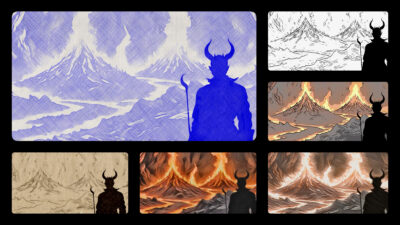
Oddtoe’s process is a hybrid workflow: generative AI models supply imagery and movement, and — for consistency and easy amendment — Oddtoe combines them with character rigging and traditional motion design. The artist designs first, generates second, then rigs, edits, and composites, so a revision is an edit, not a fresh generation.
That structure is what makes the medium dependable enough for client work: a change to a character, a colour, or a line of action is made the way animators have always made it, with the AI doing the expensive rendering underneath. Oddtoe has prototyped and documented five distinct methods — from illustration-first motion design to repeatable AI-rigged characters and straight-to-video with an illustration filter — on our AI animation process page, and the full capability lives on the generative AI animator page.
Direction is the real skill...
Why the artist matters
Anyone can generate a striking image. The difficult part is generating the same world twice: a character who looks the same in every scene, and a style your brand can use again and again. Raw AI consistency is not there yet, which is why every Oddtoe method begins with a quality illustration and lets the AI interpret the scene. The craft is in the direction.
The studio’s range comes from an unusual résumé: political cartoonist, puppeteer, data visualiser, street artist — and, since 2006, work for organisations including National Geographic. Each of those jobs relies on deciding what an image should communicate before making it, and that judgement is what generative AI work needs most.
AI systems also produce permutations, glitches, and odd choices. Under direction those can become material: Oddtoe’s original stories use that strangeness on purpose, while commercial work keeps it controlled. Either way, an artist is making the choice.
If your team is weighing up AI animation, the most useful question is who will be directing it. Send Oddtoe the brief — the studio supplies the design, rigging, and motion design that turn generated frames into a finished film.
The right tool for the brief...
When should you choose AI animation?
Choose generative AI animation when you need animated content at pace or scale — series, campaigns, screen content — or looks that would be impractical to shoot or hand-animate, and when style consistency matters enough that you want an artist directing it.
It is not the right tool for everything: some briefs are better served by hand animation, and some by live action. Oddtoe works across generative AI, motion design, and physical media, and will tell you which approach suits the brief before you commit to one.
Questions & Answers
Generative AI animation
Tell us what you are imagining...
Want to talk about a project?
"*" indicates required fields